
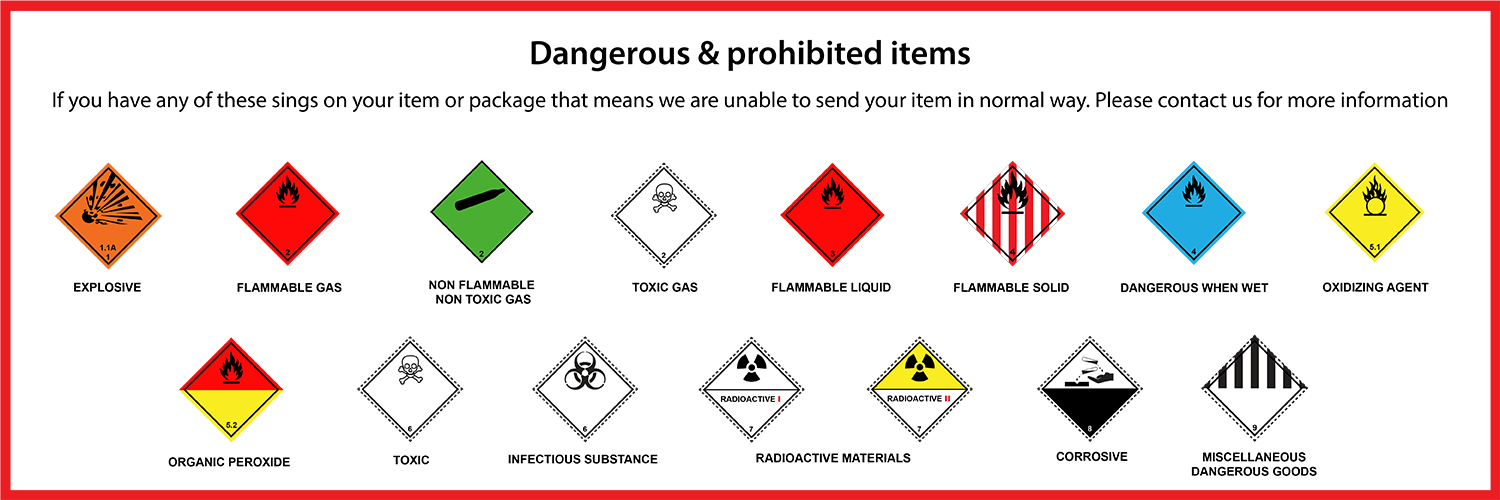


If your item displays any of these hazard signs, we cannot ship it using the standard process. Please contact us for guidance on how to proceed safely.
Materials that can detonate or explode due to heat, shock, or friction. Example: TNT, dynamite, fireworks.
Gases that ignite easily when exposed to sparks, flames, or heat. Example: Propane, butane, acetylene.
Gases that do not burn or pose a direct poisoning hazard but can displace oxygen. Example: Carbon dioxide, nitrogen, helium.
Gases that are poisonous or harmful to humans if inhaled. Example: Chlorine, ammonia, hydrogen sulfide.
Liquids that can ignite and burn easily at normal working temperatures. Example: Gasoline, alcohol, acetone.
Solids that can ignite through friction, heat, or contact with moisture. Example: Sulfur, magnesium, camphor.
Substances that react violently with water to release flammable or toxic gases. Example: Sodium, potassium, calcium carbide.
Materials that can cause or enhance combustion of other materials by providing oxygen. Example: Ammonium nitrate, potassium permanganate, hydrogen peroxide.
Unstable substances that can explode, burn rapidly, or be sensitive to shock or friction. Example: Benzoyl peroxide, methyl ethyl ketone peroxide.
Substances that can cause serious health effects or death if inhaled, ingested, or absorbed. Example: Pesticides, arsenic, cyanide.
Materials that contain or may contain pathogens (bacteria, viruses, parasites) that can cause disease. Example: Medical waste, biological samples.
Substances that emit ionizing radiation, which can cause damage to living tissue. Example: Uranium, plutonium, radioactive isotopes.
Category of radioactive materials with medium levels of radiation, requiring controlled handling. Example: Certain medical isotopes, industrial radiography sources.
Substances that can destroy or irreversibly damage other materials, including skin and metals. Example: Sulfuric acid, hydrochloric acid, sodium hydroxide.
Hazardous substances that do not fit into other categories but still pose risks during transport or storage. Example: Lithium batteries, dry ice, environmentally hazardous substances.

 New Zealand
 Australia
 Sri Lanka